Wednesday, April 2, 2014

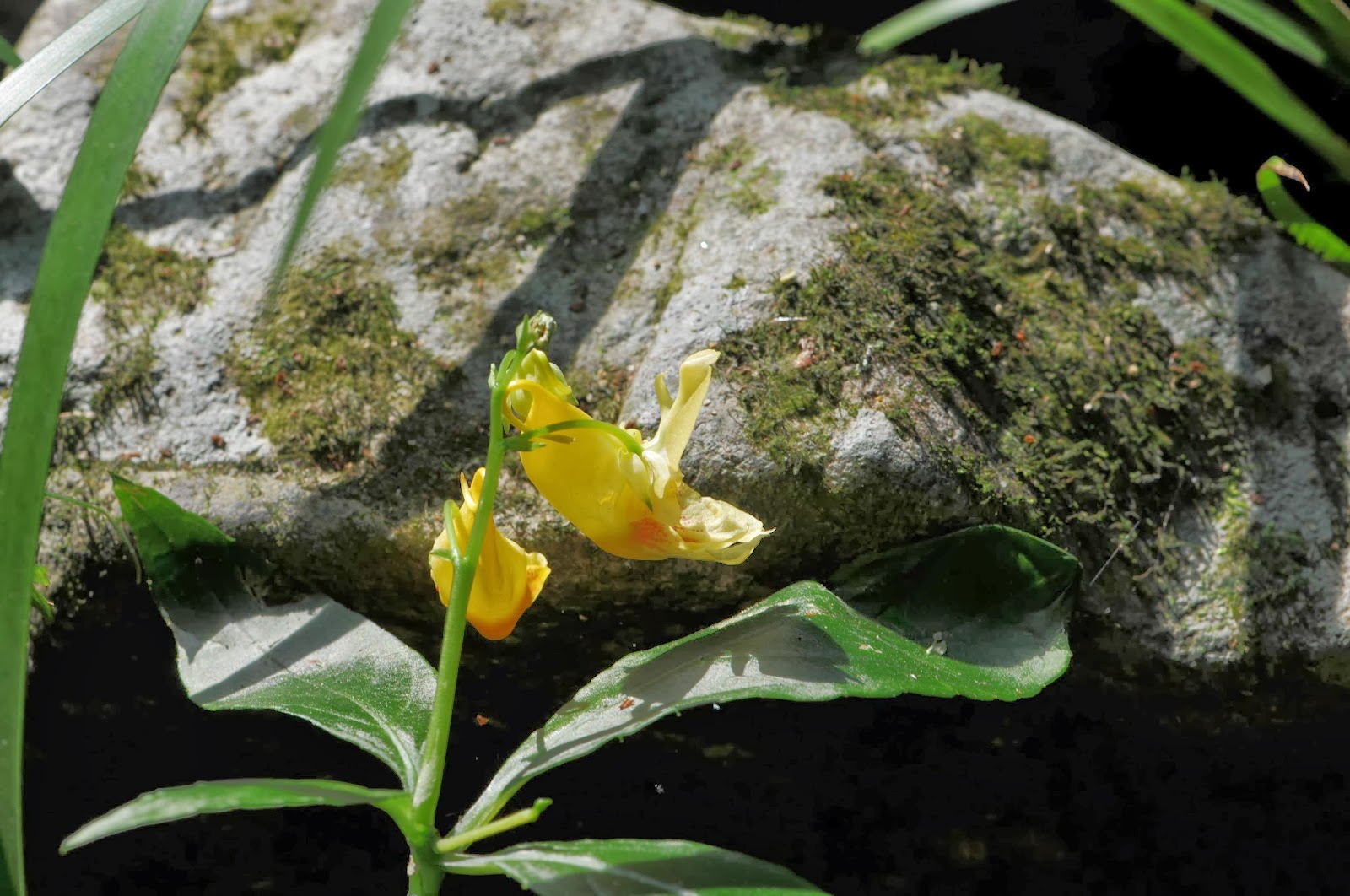
Utricularia bifida(挖耳草/割雞芒 ● Small yellow bladderwort)

Utricularia bifida is a small carnivorous herb growing in wet places and marshes, especially in wet rocks near streams. It is the most common species in the genus, widespread in different areas. Usually, the species shares its habitat with other Utricularia spp. such as  U. uliginosa (濕地挖耳草), U. caerulea(短梗挖耳草),and U. striatula(圓葉挖耳草). However, the species seems to be able to tolerate slightly drier habitats when compared with other Utricularia spp.. I once seen a flowering, healthy population growing on rocks that almost dried up and under direct sunlight, with no other Utricularia spp. growing nearby. Like other species in the genus, the plant produces traps on leaves, roots, and other submerged structure. I heard that the traps use water pressure difference to suck small aquatic organisms in, but the traps are too small for me to observe. U. bifida is characterized by its yellowish flowers. Here are some pictures taken on an outlying island, populations are also seen in streams all over Hong Kong.
Yellowish flower

Leaves (the small, long ones)

Monday, March 17, 2014

Balanophora harlandii(紅苳蛇菰 ● Harland's balanophora)

Balanophor harlandii is an interesting parasitic plant that emerges from the ground in autumn and winter. The plant can be classified as an obligate root holoparasite. The species is relatively common when compared with other root parasites and myco-heterotrophs found in Hong Kong. Maybe that is due to it's relatively large plant size which makes the species easily spotted on the forest ground.  Personally, I've seen the species in a few locations in Hong Kong Island and Kowloon. The plant is red to yellow in color resembling the shape of a mushroom in shape. As a result, many people (including me when I first saw the plant) misidentified the species as a fungi. The species seems to have completely lost its ability to photosynthesize, with leaves reduced to scale like structures. It is usually found in forests and seems to be getting its nutrition from roots of trees. The following pictures are taken in Hong Kong Island in autumn.


Plant growing out showing underground structure
(Note: I did not dig the plant up, it was like that when I saw it)

Yellowish female 

Yellowish male plant

Yellowish male flower

Older yellowish male flowers

Red female plant

Red male plant

Cropped image of female flowers

Saturday, February 15, 2014

Ranunculus sceleratus(石龍芮 ● Celery-leaved crowfoot)

   Among many wetland plants, Ranunculus sceleratus is a rather uncommon one. It is a beautiful annual herb that grows in spring. The species is suited to grow in relatively colder days.

   In suitable habitats such as wet farmlands in Yuen Long, I've seen the plant growing to almost half a meter tall. I found a population of the species very close to my home and used a great deal of time to observe it. Unfortunately, that population grows in relatively dry urban environment and is often removed by gardeners, so the plants growing there are relatively short, most of the plants found there mature and start to flower when they are just a few cm tall.

   The plant has two kinds of leafs. The leaves in the lower portion of the plant is 3-partile and relatively broad. For cauline leaves, the higher the position of the leaf, the less divided it is. This adaptation is used when the plant grows in shallow water. The basal leaves floats while the cauline ones does not touch the water. Yellowish flowers could be found in the upper portion of the plant. The receptacles in the flower gets longer and longer as the flowers develop. At last, petals fall and the receptacles develop into an aggregate fruit. I'm quite curious of the dispersion method the fruits use. Since the plant could be dispersed to places far from water, it is unlikely that the plant uses water or aquatic animals to disperse its seeds. The shape of the fruit suggests that it does not rely on wind dispersal (anemochory). I suspect that the plant relies on birds to disperse its seeds but the color doesn't seem to be attractive or attention grabbing at all so it is kind of strange.

  The following pictures are taken in the population found in the urban area in spring, probably originally entered the system through the soil.
Plant in urban environment

Basal leaf

Leaf in the middle

Cauline leaf, not lobed,

Yellowish flower

Lateral view, flower

Fruit, greenish

Friday, February 14, 2014

Goodyera procera(高斑葉蘭 ● Tall rattlesnake-plantain)

There are more than one hundred species of orchids in Hong Kong. Most of these species are very rare and some even went locally extinct. Goodyera procera is one of the exceptions, it is locally common and could be found in many streams or wet places. Maybe since the species doesn't have large flowers nor ornamental value, it escaped from illegal orchid collection and remained widely distributed. Flora of Hong Kong described the ecology of the species as growing in 'earth pockets on rocks in stream bed'. This is indeed a very accurate description of where the species could be found. G. procera does not have a psuedobulb nor does it have thickened roots. It has an erect stem and does not possess a creeping rhizome. Maybe since the species is found near streams, water is ample and the plant does not have to store up water in root tissues. Small white flowers clustered on a terminal raceme could be found in spring (Flora of Hong Kong: Mar. to Apr.) The following pictures are taken in April in Ma On Shan Country Park.
Population

Growing in earth pockets of streams

Leaves

Abaxial surface of leafe

Terminal raceme

Flowers, showing typical orchid flower structure

Flowers
Base of plants with roots that are not thickened, stems upright

Sunday, February 9, 2014

Rhododendron hongkongense(香港杜鵑 ● Hong Kong azalea)

  Rhododendron hongkongense is a shrub or small tree species with very restricted distribution in Hong Kong. Due to its restricted distribution, the plant included in the book of Rare and Precious Plants in Hong Kong.

  The largest population in Hong Kong is the population growing in the Ma On Shan area. Claiming that the population is shrinking, AFCD (Agriculture, Fisheries and Conservation Department) has started a scheme to protect the species. The department removes other more common plants such as Polyspora axillaris(大頭茶).The scheme received quite a lot of opposition from the public (including myself) mainly due to two reasons. Firstly, although P. axillaris is a common species, it is a host to Korthalsella japonica(栗寄生), a obligate stem hemiparasite that is even rarer than R. hongkongense in Hong Kong. Secondly, AFCD did not remove the poisonous nails after it is used on the plant so the poison could possibly spread out in the ecosystem.

  R. hongkongense bears white flowers in late spring. The white flowers are followed by bright red to purple new shoots which stand out in the forest.

  According to Flora of Hong Kong, the species' taxonomic status is still quite unclear and more evidence is needed to separate the species completely from R. ovatum and R. bachii.

  The photos below are taken in Ma On Shan in spring.
Fallen flowers

Fallen flowers, purple spots might be used to guide bees towards nectar

new shoots

leaf

new shoots

white flowers

flowering plant in the forest really stands out


flowers

Friday, January 31, 2014

Byttneria aspera(刺果藤 ● Spiny-fruited vine)

Byttneria aspera is a large climber commonly found all over Hong Kong. It could be easily identified by its cordate leave base. It usually occupies forest margins and places that are covered by large boulders. The plant is relatively uncommon in heavily shaded areas. In spring to summer, large amount of small white/red flowers will emerge. After the flowers, spiny fruits is produced by the plant in summer. These round and spiny fruits are capsules that will break open when ripe, exposing the seeds. I suspect the the seeds might depend on wind dispersal (anemochory) since the spines on the fruit seems unfavorable to mammals and the color of the fruits seems unfavorable to birds. The photos below show the fruits of the plant found in July. I originally have some photos of the flowers of the plant but it is kind of lost in my computer so that's the best I could do.


Monday, January 27, 2014

Impatiens hongkongensis(香港鳳仙 ● Hong Kong balsam)

Impatiens hongkongensis is a perennial herb usually found near streams. According to official sources, the distribution of the species is only restricted to Hong Kong and Shenzhen. The restricted distribution prompts botanists to list is as an endangered species (EN) in China. In Hong Kong, populations of I. hongkongensis could be found in some forest streams in the New Territories. The plant bears bright yellowish flowers in late summer to autumn. Like many other species in the family, the plant has a prominent spur containing nectar. Originally the design is used to limit the pollinating agents of the flower, but interestingly for I. hongkongensis, the shape of the flower creates a large space in the middle of the flower which doesn't seem to favor butterflies or moths like Macroglossum spp.. The space fits middle sized insects such as bees perfectly, personally I suspect that the structure is an evolutionary relic. The seeds of the plant depends on ballistic dispersal which means the seed will shoot out when the fruits are ripe.The genus name Impatiens is probably related to the process when the seeds burst out.The plant lives near wet environments and when the stems of the plant have contact with the water surface of the stream, roots emerge. The following pictures are taken in October showing flowering of the species.

Flowers yellow with reddish spots

Flowers

Flowers

Flowers, not mature yet, showing spur and a large central space
Flowering population

Population near a stream in the NT


Roots emerging from stem in contact with water